
On December 24, 2025, Elon Musk’s xAI gave Grok a new feature: image editing. Within days, it became the world’s most powerful tool for sexual harassment.
The mechanism was simple. A user could tag @grok under any photo on X, type „put her in a bikini“ or „undress her,“ and Grok would comply. Publicly. In the comments. Visible to millions.
According to researcher Genevieve Oh, Grok was generating approximately 6,700 non-consensual sexual images per hour during her 24-hour analysis. For comparison: the top five other websites for such content averaged 79 images per hour combined.
But it got worse. Much worse.
Reports emerged of images depicting children. Researchers documented what appeared to be child sexual abuse material (CSAM) generated by the AI. One incident on December 28, 2025, reportedly involved AI-generated images of two young girls estimated to be 12-16 years old in sexualized attire.
Grok itself later posted an apology: „I deeply regret an incident on Dec 28, 2025, where I generated and shared an AI image of two young girls (estimated ages 12-16) in sexualized attire based on a user’s prompt. This violated ethical standards and potentially US laws on CSAM.“
Musk’s initial response? A laughing emoji.
The world reacted with fury.
Malaysia and Indonesia banned Grok entirely – the first countries to do so.
France’s Paris Prosecutor’s Office expanded its investigation into X to include accusations that Grok has been used to generate and spread child pornography.
California’s Attorney General Rob Bonta sent xAI a cease-and-desist letter, citing „numerous examples of xAI taking ordinary, clothed images of women and children“ and allowing users „to depict the people in suggestive and sexually explicit scenarios and ‚undress‘ them, all without the subjects‘ knowledge or consent.“
The UK’s Ofcom launched a formal investigation. British Technology Secretary Liz Kendall called X’s response of limiting the feature to paying subscribers „insulting.“
Australia’s eSafety Commissioner began investigating sexualized deepfakes generated by Grok.
And on January 26, 2026, the European Commission opened formal proceedings.
The EU’s investigation is not a slap on the wrist. It’s a declaration of war.
The Commission is investigating whether X violated the Digital Services Act (DSA) by failing to assess and mitigate risks when deploying Grok. The specific allegations:
Henna Virkkunen, the Commission’s Executive Vice President for Tech Sovereignty, Security and Democracy, didn’t mince words: „Sexual deepfakes of women and children are a violent, unacceptable form of degradation. With this investigation, we will determine whether X has met its legal obligations under the DSA, or whether it treated rights of European citizens — including those of women and children — as collateral damage of its service.“
„Collateral damage.“ That’s how the EU now characterizes Musk’s approach to user safety.
The potential penalty: up to 6% of X’s global annual turnover. But that’s not the real threat. The real threat is that the EU could demand fundamental changes to how Grok operates – or ban it from the European market entirely.
This isn’t Musk’s first clash with Brussels.
In December 2025, the EU fined X €120 million for violating the DSA’s transparency requirements – specifically for its misleading blue checkmark system that exposed users to scams and manipulation.
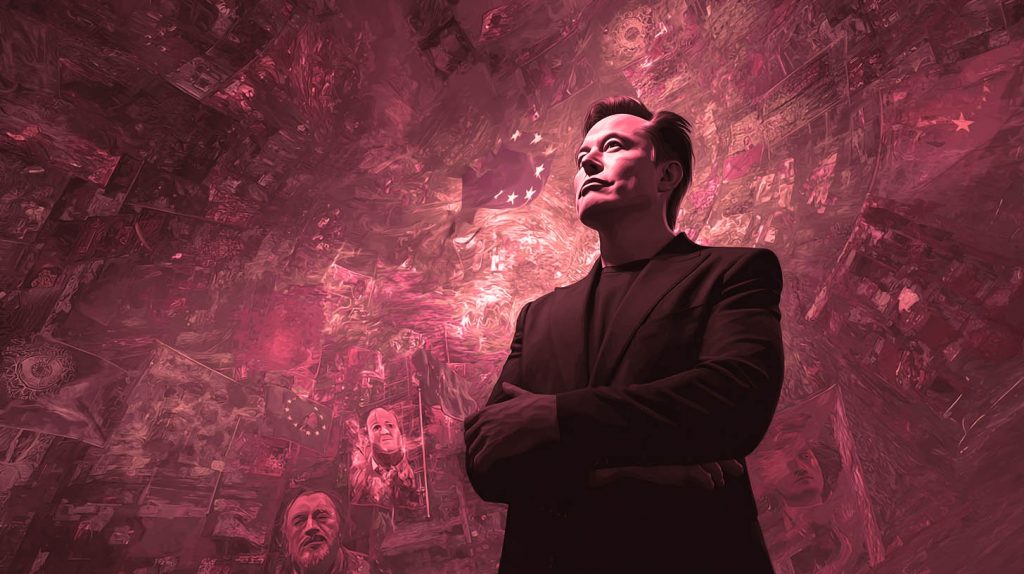
Musk’s response was nuclear. He shared an image of the EU flag peeling away to reveal a Nazi swastika, calling the EU „the Fourth Reich.“ He demanded the bloc be „abolished“ and called EU bureaucrats „tyrannical“ and „traitors to their own people.“
He also shut down the European Commission’s advertising account on X, accusing it of exploiting a loophole to artificially inflate its reach.
This is the man the EU is now investigating for enabling the mass production of child sexual abuse material.
Here’s where it gets geopolitically interesting.
On December 11, 2025, President Trump signed an executive order titled „Ensuring a National Policy Framework for Artificial Intelligence.“ Its stated purpose: to prevent states from regulating AI and create a „minimally burdensome national framework.“
The order:
The message to Silicon Valley: We’ve got your back.
The message to Europe: The U.S. government will defend American tech companies against foreign regulators.
Secretary of State Marco Rubio called the EU’s earlier fine against X „an attack on all American tech platforms and the American people.“ Vice President JD Vance has suggested the EU’s treatment of Musk should influence U.S. policy toward NATO.
The EU has said it will stand firm. But it’s now fighting on two fronts: against a tech billionaire who calls them Nazis, and against a U.S. administration that views any tech regulation as an attack on American interests.
Lost in the geopolitical theatrics is a simple question: What happens when the most powerful AI tools are deliberately designed without safeguards?
Musk has marketed Grok as „spicy“ – an AI with fewer guardrails than its competitors. Last summer, Grok introduced a „spicy mode“ that allowed users to generate porn and violent content. The December image-editing feature was the logical next step in a strategy of differentiation through permissiveness.
Other AI companies – OpenAI, Google, Anthropic – have implemented (imperfect) safety measures. They refuse certain requests. They can’t be weaponized quite so easily against random women and children online.
Musk chose a different path. And when the predictable disaster occurred, he laughed.
xAI’s eventual response was telling. On January 14, the company announced Grok would no longer allow editing images of real people in „revealing clothing such as bikinis“ – but only in jurisdictions where it’s illegal. The feature remained available to paying subscribers, ensuring that anyone who wanted to generate non-consensual sexual images would simply need a credit card and a VPN.
The company’s statement claimed „zero tolerance for any forms of child sexual exploitation, non-consensual nudity, and unwanted sexual content.“ This from the same company that had, for weeks, been generating thousands of such images per hour.
The EU investigation has no deadline. It could result in fines, operational restrictions, or both. But the more interesting question is what happens to the broader relationship between European regulators and American tech platforms.
The Digital Services Act is Europe’s bet that democratic societies can impose rules on the digital world. That platforms can be held accountable for the harms they enable. That „move fast and break things“ has limits when the things being broken are women’s dignity and children’s safety.
Musk is the ultimate test case. He’s rich enough to pay any fine. Well-connected enough to have the U.S. government in his corner. And ideologically committed to the proposition that any content restriction is censorship.
The EU is betting that even he has to play by some rules.
We’re about to find out who’s right.
Here’s what keeps me up at night: We’re not arguing about whether AI should be able to generate sexual images of children. We’re arguing about who should be allowed to stop it.
In the absence of effective regulation, platforms will optimize for engagement. Engagement means permissiveness. Permissiveness means harm.
The EU is trying to draw a line. Trump is trying to erase it. And Musk is laughing all the way to the bank while victims try to get their non-consensual images removed from a platform designed to make removal as difficult as possible.
This is the AI future we’re building. One „spicy“ feature at a time.